Structured authoring
DITA topics, maps, XML source, information typing, controlled relationships, and publication-oriented content organization.
Technical Writing · Structured Authoring · DITA
A DITA-based technical documentation prototype for a fictional industrial energy system.
The product is fictional. The documentation architecture, structured source, reusable content model, publishing workflow, and WebHelp outputs are the work sample.
Publication
Audience-filtered WebHelp publication focused on system operation, monitoring, and operator response.
Open Operator Documentation →Publication
Audience-filtered WebHelp publication demonstrating role-specific content delivery from the same source.
Open Installer Documentation →What this demonstrates
The project treats documentation as an information system rather than a collection of standalone documents. Content is modeled, structured, reused, filtered, and assembled into audience-specific publications.
DITA topics, maps, XML source, information typing, controlled relationships, and publication-oriented content organization.
Canonical component definitions using
conref and conkeyref,
plus DITA keys and key references for controlled
terminology.
A shared DITA source produces separate Operator and Installer publications through profiling and conditional processing.
Custom Oxygen WebHelp Responsive templates, XHTML fragments, CSS customization, responsive presentation, and cross-publication navigation.
System decomposition, information requirements, audience and task analysis, reusable information modeling, and documentation gap identification.
One structured source can support multiple publications without duplicating the underlying content.
System model
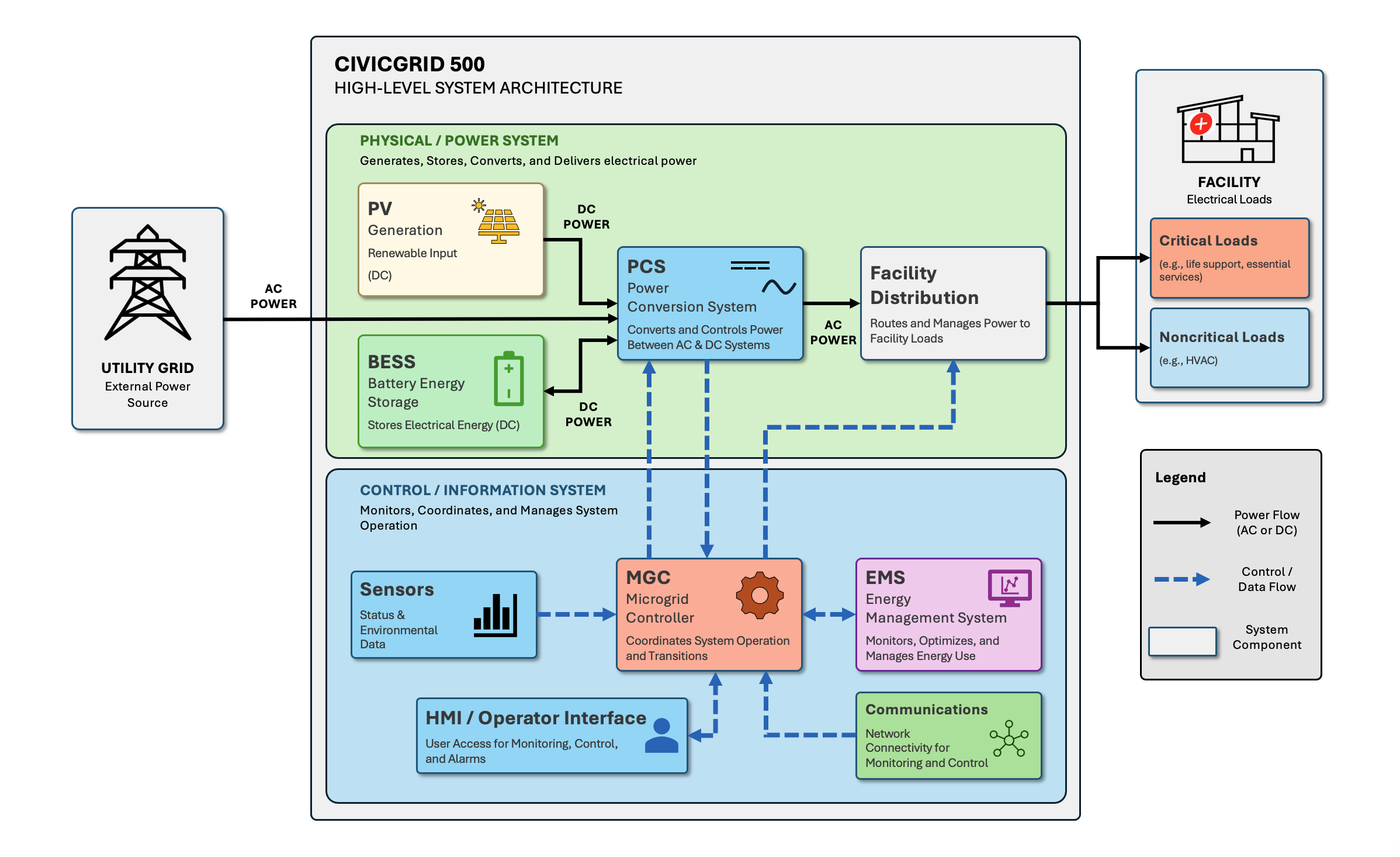
The documentation set begins with a system-level model separating the physical power system from the control and information system.
Documentation workflow
01
Establish system purpose, architecture, boundaries, terminology, and operating context.
02
Decompose the system and identify actors, tasks, functions, and information requirements.
03
Map information requirements to DITA topics, reusable content, maps, and publication structures.
04
Apply profiling and publication templates to produce audience-specific WebHelp outputs.
Technical notes
This prototype was authored in Oxygen XML Editor using DITA and published as customized WebHelp Responsive output. The documentation source remains separate from the publication presentation layer.
The system is intentionally conceptual and does not represent an engineered or production-deployed energy system. Product and component behavior shown here is part of the fictional CivicGrid documentation model.